Cahier · Visual essay
Les Gilets Jaunes The Yellow Vest Movement · Volume 2
A day of protest over living costs became a dispute over violence, order and representation. Who gets to speak for the people in the street?
Companion episode · Vol. 2
Audio version coming later. Browse the podcast
01 Why Yellow?
French drivers carry a high-visibility vest for roadside emergencies. In 2018, protesters adopted it during fuel-tax blockades. A familiar safety object became a way to demand political attention.
- RedThe left
- BlueThe right
- GreenThe Greens
Reading Yellow
Yellow offered distance from familiar party labels: a way to enter politics without wearing a party's colors.
Horizontal organizing left room for people across the political spectrum. But that freedom had a cost: television could turn a few visible voices into unofficial spokespeople, allowing their views to crowd out others. The far-right National Rally sought influence, fueling fears of appropriation; this was not evidence of control over the whole movement.
02 The Day
- Morning
Early Gatherings
Early reports described gatherings in Valenciennes in the north, La Rochelle in the west, Brignoles in the south and Clermont-Ferrand in central France (Nice-Matin, morning reporting). Road blockades were also reported in Rennes and Saint-Nazaire (RTL live coverage).
- Afternoon
Nationwide Marches
Crowds marched in Paris, Lyon, Toulouse, Rennes and other cities. Students joined workers, retirees and trade unionists.
- Evening
Crowd Counts
About 550,000 nationwide, including roughly 110,000 in Paris: the Interior Ministry's estimate, reported by TF1 Info. Around 800,000 nationwide: the organizers' claim, reported by RTL. These are attributed estimates, not an independently agreed total.
- Night
Clashes
Buildings and businesses were attacked in several cities. Confrontations injured protesters and police. Political responses increasingly focused on violence and public order.
03 Street Demands
Before leaders name the crowd, I want to hear some of its demands. These are reported individual voices, not a common platform or a representative survey.
Franck · demonstrator in Guéret
Wage Pressure
“At the end of the month, I have nothing left. Prices go up, but wages don't. We can't take it anymore; we're suffocating.”
My reading · Amine Zidouh
“Prices go up, but wages don't” describes an imbalance between costs and income. I notice the move from “I” to “we”: an individual budget becomes a shared grievance. “Suffocating” gives that financial pressure a bodily expression.
Johanna · nurse in the Paris march
Public Funding
“I am demonstrating so that things change, and so that more money is allocated to public services!”
My reading · Amine Zidouh
I read “so that” as a link between protest and a concrete demand: more funding for public services. The passive “is allocated” leaves the decision-maker unnamed, but directs attention to a political choice about how public money is distributed.
Lina · student and aspiring teacher in Paris
Future Pupils
“I am demonstrating for my little brother, who is at high school, but also for the future children I will teach.”
My reading · Amine Zidouh
She names her brother and the children she expects to teach as reasons for marching. I read the repeated “for” as a claim of responsibility toward others. The sentence joins a family relationship to a future professional one, extending her concern beyond her own education.
Peaceful marches and serious violence occurred during the same day. Neither fact makes every participant responsible for what happened nearby.
Final arrest and injury totals were unsettled when this essay was prepared. They are omitted here; the ministry and organizer crowd estimates remain separately attributed.
04 Claiming Representation
I use critical discourse analysis to ask who is named, who acts, who is blamed and who can say “we.” I apply those questions to the presidency, the far-right National Rally and Jean-Luc Mélenchon's left-wing La France Insoumise, or France Unbowed. These are my interpretations of their words, not proof of hidden motives.
Presidential Rhetoric
Emmanuel Macron
A social-media statement, then the longer televised address. The second text must not be reduced to the first.
National Unity
“We will all stand together against the sowers of chaos, who seek only to bring down our institutions and prevent those peacefully expressing their demands from doing so.”
My reading · Amine Zidouh
“We will all” claims unity without establishing who agrees. I read “sowers of chaos” as a division between a national “we” and people placed outside it. “Seek only” assigns a single motive, treating an intention to destroy institutions as settled.
Explaining Violence
“How can French people do this to France? […] Nothing justifies it. Nothing explains it. Nothing excuses it.”
My reading · Amine Zidouh
“Nothing” gives justification, explanation and excuse the same repeated form. I separate those operations: explaining violence does not excuse it. The question about French people acting against France adds a national accusation to the condemnation of particular acts.
Two Responsibilities
“Our responsibility is therefore twofold. To hear the anger and act on its causes, and to firmly uphold republican order.”
My reading · Amine Zidouh
“Twofold” presents hearing anger and upholding order as compatible duties. I read “act on its causes” as a commitment to address grievances, though the excerpt names neither a cause nor a policy. “Our responsibility” places that work with the speaker's collective “our,” whose boundaries are left unspecified.
One Aim
“All those who tell you today that the urgent thing is to take to the streets, to demonstrate, to create disorder, have only one aim. To damage the Republic and steal the debate.”
My reading · Amine Zidouh
I read the sequence “take to the streets … demonstrate … create disorder” as a slide from a political act to a disturbance. The target is those urging mobilization. “All” and “only one aim” assign them a single destructive purpose, leaving no room for calls to protest over policy.
Jordan Bardella
National Rally · Before and after the march
Loaded List
“They will gather around all the full-time union officials, violent groups and anti-police militias France has.”
My reading · Amine Zidouh
“Will gather” predicts the composition before the march. In the same list, “union officials” sit beside “violent groups” and “anti-police militias.” I read that proximity as guilt by association; the sentence offers no separate account of what the union officials will do.
Two Frances
“I am extremely worried about this day, which is not a day dedicated to the France of work, but which is, under cover of legitimate demands, a day for the France of chaos.”
My reading · Amine Zidouh
He refuses the label “France of work” for the mobilization and gives it “France of chaos.” I read that division as excluding protesting workers from his image of working France. “Under cover” acknowledges legitimate demands while treating their expression here as a disguise.
Silent Majority
“From May 2027, if the silent majority of French people so decides, we will durably restore order.”
My reading · Amine Zidouh
“If” acknowledges that a future vote is needed. Yet “the silent majority” names a majority before that vote has established one. I read “restore” as a claim that order has been lost and can be recovered by his camp. “Durably” promises that its return would last.
Marine Le Pen
National Rally · October 17
Hostage Metaphor
“Legitimate social demands have once again been taken hostage by the far left and the speeches of Jean-Luc Mélenchon's MPs.”
My reading · Amine Zidouh
“Legitimate” validates the demands; “taken hostage” depicts them as seized by an outside force. I read the sentence as separating acceptable grievances from the left-wing actors expressing them. “Once again” presents this capture as a recurring pattern without providing examples in this excerpt.
Assigned Intent
“By legitimizing violence, by considering order an oppression and disorder a right, [they] seek to plunge the country into chaos.”
My reading · Amine Zidouh
Le Pen puts two judgments into her opponents' mouths: order is oppression, disorder is a right. I read the repeated “by” as a chain leading from those attributed beliefs to “chaos.” “Seek to” makes the final step an allegation of intention, rather than a description of an outcome.
Jean-Luc Mélenchon
La France Insoumise · October 17
Police Intent
“Confrontation seems to be the purpose of this strategy of ‘maintaining order’. Shameful.”
My reading · Amine Zidouh
“Seems” marks uncertainty, but “purpose” suggests that confrontation is intended. The quotation marks around “maintaining order” question the official description of police action. I read “Shameful” as a moral verdict appended to that suggestion; this excerpt does not supply evidence that confrontation was the aim.
Claimed Unity
“Monsieur Lecornu, you played with fire. By counting on the situation deteriorating, you only succeeded in bringing all the youth and the workers' unions together in solidarity.”
My reading · Amine Zidouh
Lecornu is the prime minister. “Played with fire” blames him for risking escalation, while “counting on” attributes a deliberate strategy of deterioration to him. I read “only succeeded” as a reversal: the alleged strategy produces solidarity instead. “All the youth” gives that solidarity a scope this statement cannot establish.
05 Shared Moments
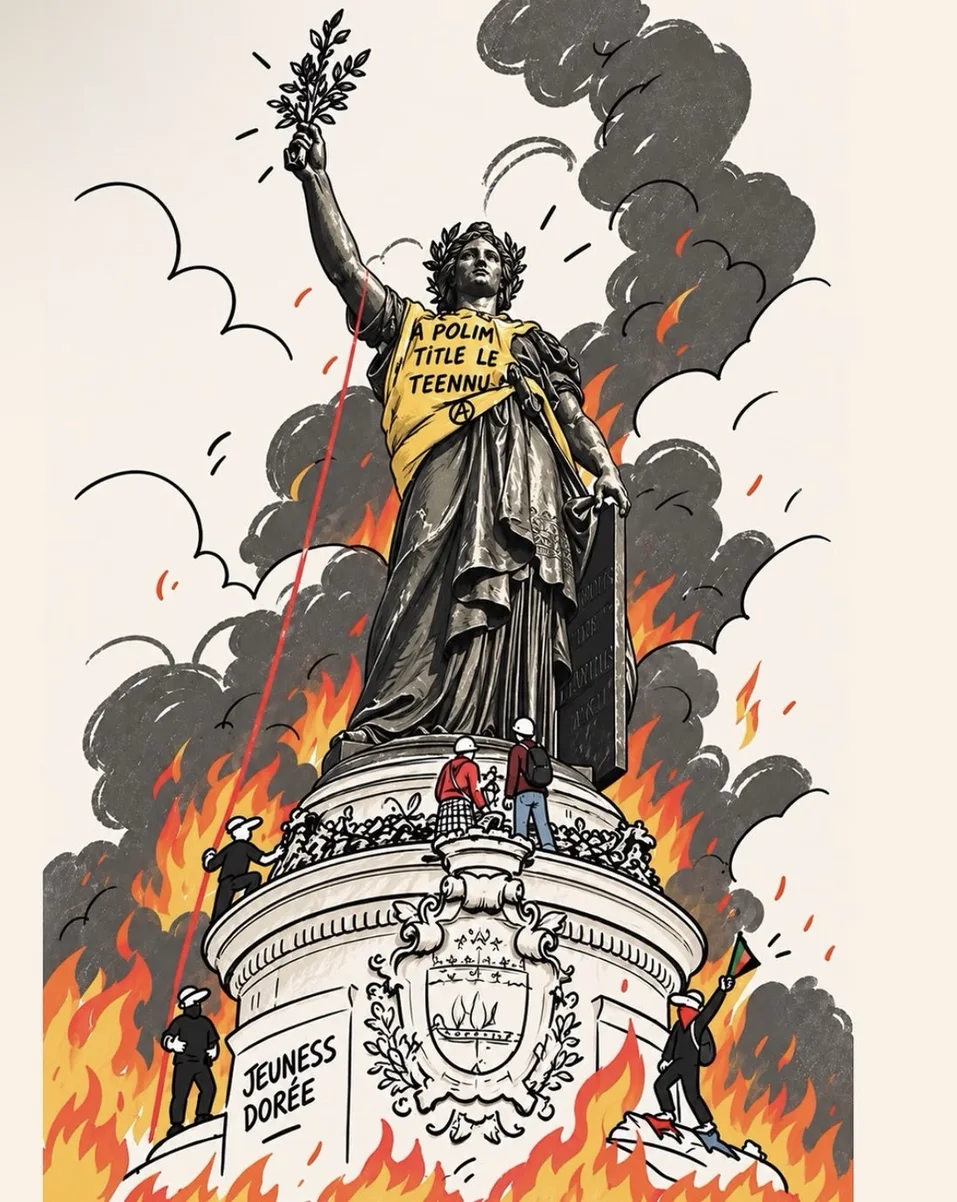
An orchestra, Marianne in a yellow vest, and acts of care in the crowd. These scenes were also part of the day's mobilization.
Live Music
Orchestra Protests
The Orchestre du Nouveau Monde joined the mobilization at République. Its repertoire included Avengers music (Watson's reporting and footage). The musicians were exposed to tear gas during rehearsal and eventually had to disperse, according to the orchestra's account to Télérama.
Republic Recast
Marianne
Protesters dressed the statue of Marianne at the Monument to the Republic, Place de la République, in a yellow vest. Its inscription accused police of maiming high-school students (AFP's report; the credited photographic record).
Everyday Democracy
Mutual Care
France 24 recorded Damien offering help to people affected by tear gas, teenagers dancing to encouragement, and adults marching alongside young people (Pauline Rouquette's street report).
I see democratic value in these small relations: making room, sustaining another person, allowing joy alongside anger. They challenge the claim that the crowd's only common action was destruction.
Political Stakes
I see a government being challenged over wages, schools, hospitals and living costs. I will judge its response by what changes in people's pay and public services, and by how protesters are treated.
Macron is in his second presidential term. I hold him partly responsible for the situation behind these grievances. The election is already in his address and Bardella's post. My concern is which demands survive the competition for protesters' support.
06 Image Notebook
I am keeping this space open for photographs I will add to the essay. Each image will carry its own date, place, credit and caption, rather than stand in for the entire movement.
The Orchestra
Photograph to come
Marianne
Photograph to come
Street Voices
Photograph to come